Summary
Agentic AI is quickly moving from experimentation to real-world adoption. Across the UAE, organizations are exploring AI systems that do more than respond to prompts. These systems can plan tasks, call tools, make decisions, and adapt based on outcomes.
While the potential is exciting, the architecture behind agentic AI matters more than many teams realizes. Without the right foundations, these systems can become hard to secure, expensive to run, and difficult to control.
In this guide, we’ll walk through how to architect secure, scalable agentic AI workflows on AWS, using clear language and practical examples. You’ll learn how agentic workflows work, what makes them different, and how to design them in a way that supports enterprise security, governance, and growth particularly for organizations operating in the UAE.
Why Agentic AI Architecture Matters for UAE Organizations
Agentic AI is gaining momentum across sectors such as government services, financial institutions, logistics, real estate, and smart city initiatives. These use cases often involve sensitive data, strict compliance requirements, and high expectations around reliability.
Unlike traditional AI models that answer a single question, agentic systems operate in loops. They reason for a goal, decide on next steps, use tools or APIs, and evaluate results before continuing. This autonomy introduces new architectural risks.
Poorly designed agentic systems can:
- Access data or systems they shouldn’t
- Trigger unintended actions
- Scale unpredictably and drive-up costs
- Become impossible to audit or explain
This is where cloud-native architecture becomes critical. Platforms like Amazon Web Services provide the building blocks needed to design agentic workflows that are secure, observable, and ready for enterprise scale when used correctly.
What Are Agentic AI Workflows?
An agentic AI workflow is an AI-driven process where the system can decide what to do next, rather than waiting for a human to prompt at every step.
At a simple level, most agentic systems include four elements:
- Reasoning: The AI understands the goal and plans actions
- Tools: APIs, databases, or services the agent can use
- Memory: Context from previous steps or past interactions
- Feedback: Evaluation of results before continuing
For example, an operations assistant might detect an issue, analyze logs, attempt remediation, verify the fix, and notify a human without manual intervention.
In the UAE context, this could support:
- Automated compliance checks and reporting
- Intelligent customer service escalation
- Monitoring and optimization of large infrastructure environments
The key difference is autonomy. And autonomy requires careful design.
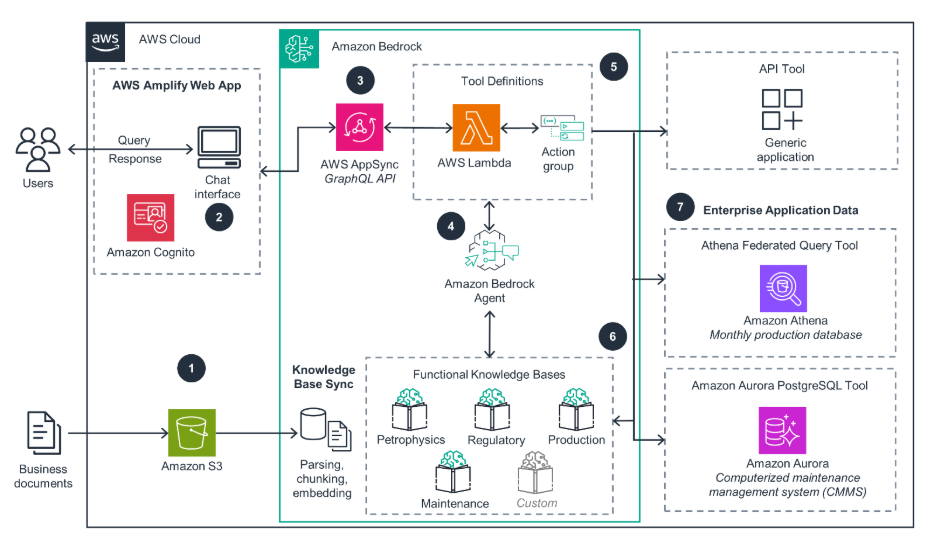
Image Source: https://aws.amazon.com/solutions/guidance/agentic-workflow-assistants-on-aws/
Core Principles for Designing Agentic AI on AWS
Before diving into services or diagrams, it helps to align a few principles that guide successful agentic architectures.
Security Comes First
Agentic AI should never be treated like a trusted human user. Each agent must operate with strictly limited permissions. If an agent only needs to read data, it should never have written access. If it only needs one tool, it should not see others.
Clear boundaries reduce risk and make systems easier to govern.
Design for Scale from Day One
Agentic workloads are often bursty. A quiet system can suddenly receive hundreds or thousands of tasks. Event-driven and asynchronous designs allow systems to scale horizontally without overloading individual components.
Keep Humans in Control
Even the most advanced agentic systems should include checkpoints. Human approval, audit trails, and rollback paths are essential especially in regulated or customer-facing environments.
A High-Level Reference Architecture for Agentic AI Workflows
A well-designed agentic architecture separates concerns. Instead of one large “super-agent,” responsibilities are distributed across layers.
At a high level, most architectures include:
- Agent reasoning layer for decision-making
- Orchestration layer to manage workflow steps
- Tool execution layer for calling APIs or services
- Memory and knowledge layer for context and retrieval
- Observability and governance layer
Mapping these components to managed cloud services improves reliability and reduces operational burden. AWS prescriptive guidance often highlights this separation because it allows teams to scale and secure each part independently.
This approach also makes it easier to evolve the system over time without major rewrites.
Securing Agentic AI Workflows End to End
Security is one of the biggest concerns when deploying autonomous systems. The goal is not to limit innovation, but to ensure agents operate within safe boundaries.
Identity and Access Management for Agents
Each agent should have its own identity and role. Temporary credentials work better than long-lived access keys, and permissions should align tightly with the agent’s purpose.
This approach limits the blast radius if something goes wrong.
Protecting Prompts, Memory, and Data
Prompts, responses, and agent memory often contain sensitive information. Encrypting data in transit and at rest is essential but so is deciding what should not be shared with the agent at all.
In the UAE, organizations must also consider data residency and regulatory expectations, especially when handling customer or government data.
Guardrails and Safety Controls
Guardrails act as policy checks before or after agent actions. They help ensure agents do not take unsafe steps, even if the reasoning model suggests it.
This includes:
- Limiting which tools can be used
- Restricting action frequency
- Validating outputs before execution
Designing for Scalability Without Losing Control
Agentic systems must scale without becoming chaotic.
Orchestrating Multi-Step Workflows
Most agentic workflows involve multiple steps that may take time. Asynchronous orchestration allows tasks to pause, resume, retry, or fail gracefully without blocking other work.
This design is well suited for long running or complex processes.
Stateless vs Stateful Agents
Stateless agents are easier to scale, as they do not rely on local memory. When memory is needed, storing it externally allows agents to remain lightweight while retaining context.
This separation improves fault tolerance and makes recovery easier.
A Practical Blueprint: Your First Agentic Workflow
Many teams struggle to move from theory to implementation. A simple, structured approach helps.
Start by clearly defining the agent’s role and limits. Avoid vague instructions. Be explicit about what the agent can and cannot do.
Next, break complex tasks into smaller responsibilities. A supervising agent can coordinate specialist agents; each focused on a narrow function.
Connect tools using APIs or serverless functions, and ensure each integration is well-defined. Add memory only where it adds value, such as retrieving relevant documents or previous outcomes.
Before moving to production, test extensively. Tracing tools help teams understand why an agent decided, not just what it did.
Finally, prepare for real-world use by separating development and production environments, versioning agent configurations, and planning for change.
Observability, Governance, and Auditability
If you cannot observe an agentic system, you cannot trust it.
Monitoring should capture:
- Agent decisions and actions
- Tool usage and outcomes
- Errors, retries, and delays
- Cost and performance trends
Auditability is especially important for regulated industries. Teams should be able to answer simple questions: What did the agent do? Why did it do it? Who approved it?
Good observability turns agentic AI from a black box into a manageable system.
Managing and Optimizing Costs
Agentic AI introduces new cost drivers, including reasoning cycles, orchestration steps, and data storage.
Cost optimization starts with design:
- Avoid unnecessary loops
- Cache repeated results
- Summaries or prune memory
- Choose asynchronous execution where possible
Clear visibility into usage patterns allows teams to balance performance with budget expectations.
Common Architecture Mistakes to Avoid
Several patterns show repeatedly in struggling projects.
One is building a single, all-powerful agent. This increases risk and complexity. Another is granting broad permissions “for convenience,” which often backfires.
Tightly coupling models to infrastructure also limits flexibility. And leaving observability until production almost guarantees surprises.
Avoiding these mistakes saves time, money, and credibility.
How SUDO Consultants Helps UAE Businesses Build Agentic AI on AWS
Designing agentic AI is not just about choosing tools. It’s about making the right architectural decisions early.
SUDO Consultants helps organizations:
- Design secure, scalable AWS-native agentic architectures
- Embed governance and compliance from the start
- Optimise performance, reliability, and cost
- Support long-term AI-driven digital transformation
If you’re exploring agentic AI workflows and want to move forward with confidence, our team can help you design systems that are ready for real-world use.
Final Thoughts
Agentic AI has the potential to transform how organizations operate. But autonomy without structure leads to risk.
By focusing on security, scalability, and observability, teams in the UAE can build agentic AI workflows that are powerful, trusted, and sustainable.
The right architecture doesn’t just support innovation; it makes it safe to scale.
AWS Bedrock AgentCore provides a unified solution covering essential functionalities like observability, tool execution, security, and memory management. It supports open-source agent frameworks such as Llama, LangChain, and Crew AI, enabling a versatile, scalable, and secure foundation for agentic AI workflows.