

Building Delivery Confidence on AWS
By the SUDO Consultants team, an AWS Premier Tier Partner helping enterprise teams across the UAE, Saudi Arabia, and the wider MENA region build production-grade delivery pipelines on AWS.
Meta title: Delivery Confidence on AWS: CI/CD, DORA & Rollbacks | SUDO
Meta description: Learn how an AWS CI/CD pipeline eliminates manual deployment risk. Covers DORA metrics, blue/green deployments, and DevOps automation for MENA enterprises.
Delivery speed is not a technical metric. It is a business outcome. Every time a deployment fails, rolls back, or triggers a release freeze, the cost appears somewhere leadership can see: a missed launch window, a customer who abandons during an outage, a senior engineer spending Friday night firefighting instead of building.
Across enterprise teams in the UAE and KSA, deployment risk is one of the most consistently underestimated business problems in technology. This blog covers why it costs more than most teams realize, what a production-grade delivery pipeline on AWS looks like, how to measure your team against the benchmarks that matter, and where AI agents are taking this next.
At SUDO Consultants, an AWS Premier Tier Partner working with banking, retail, logistics, and government teams across the UAE, Saudi Arabia, and the wider MENA region, we design and build the delivery pipelines described below, and the guidance here comes from that hands-on work.
1. What a Failed Deployment Actually Costs
Most teams measure deployment failures by time to recovery. That is the right operational question but the wrong business question. The business question is: what did this cost across every dimension?
| Cost Area | What It Looks Like in Practice |
| Revenue | Transactions lost during downtime, SLA penalties, emergency overtime, re-deployment spend |
| Customer trust | Support ticket spike, churn risk, social media exposure, reputation repair timeline |
| Engineering productivity | Sprint goals missed, senior engineers in incident response, rushed fixes creating future debt |
| Leadership confidence | Release freezes, board scrutiny, roadmap delays, harder to justify future investment |
Gartner estimates the average cost of IT downtime at over 5,600 USD per minute. For payment platforms and banking applications in the region, that is the number your CFO starts calculating the moment a deployment alert lands in a group chat.
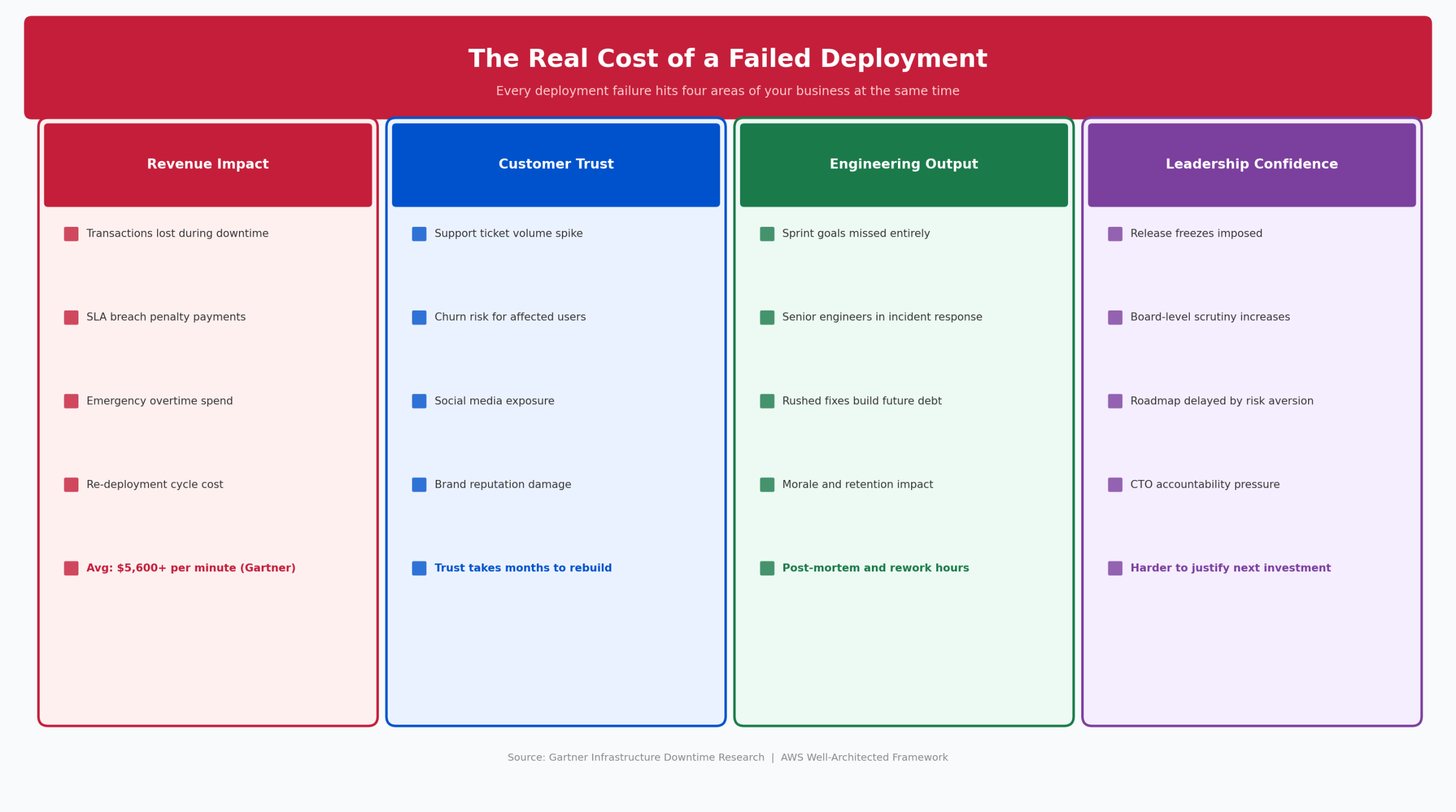
Figure 1: The four business dimensions of a failed deployment. Engineering teams report on one. Leadership cares about all four.
2. Why Teams Are Still Deploying Manually
The justifications for manual deployment are not irrational. They reflect real experience and real risk aversion.
We tried to automate and it broke something. Poorly designed automation can amplify risk. The answer is better automation design, not a return to manual processes.
Our application is too complex to automate. Complexity is rarely the real barrier. The barriers are undocumented dependencies and inconsistent environments. Automation surfaces those problems. Avoiding automation avoids the harder conversation.
Everything is running and we do not want to risk it. The most expensive reason. A team that deploys monthly because everyone is afraid to release is not stable. It is brittle. The risk has not been eliminated. It has been concentrated into one high-stakes event every four weeks.
| Manual Deployment | Automated Pipeline |
| Tribal knowledge dependent | Documented, versioned, repeatable |
| One missed step causes an outage | Automated gates catch issues before production |
| Deploys happen nights and weekends | Deploy any time with confidence |
| Rollback is manual and risky | Automated rollback via CloudWatch alarm |
| No audit trail | Full deployment history and approval log |
3. Measuring Delivery: The DORA Framework
Delivery confidence is measurable. The DORA metrics, from the DevOps Research and Assessment programme, are the four numbers that tell you more about the health of your delivery process than any internal dashboard. They are increasingly what investors, enterprise procurement committees, and boards ask for in technology due diligence.
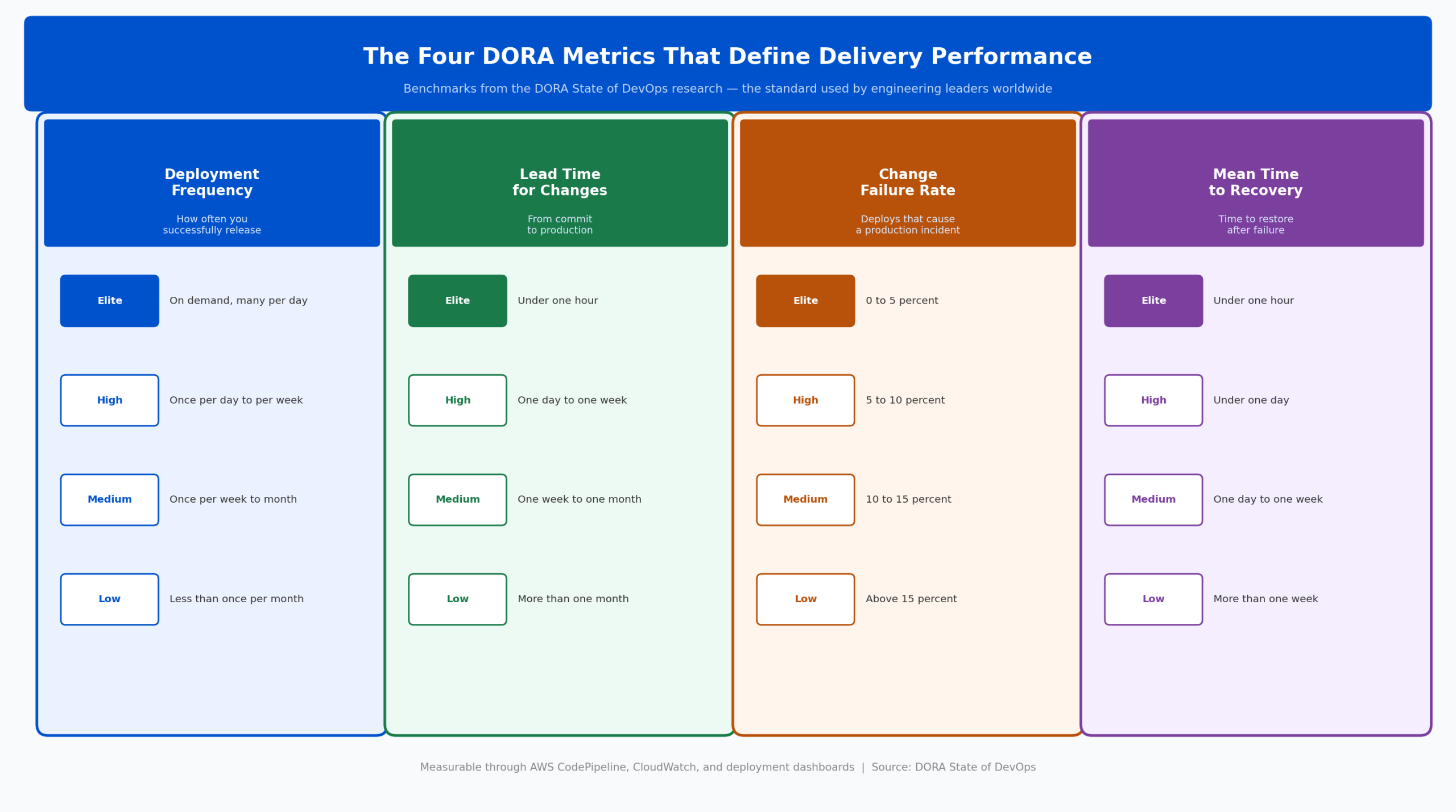
Figure 2: DORA benchmarks by performance tier. The gap between most MENA enterprise teams and Elite performers is pipeline investment, not team size.
- Deployment Frequency: How often you successfully release. Elite teams deploy on demand. Most MENA teams deploying manually sit at Low or Medium, releasing monthly or less.
- Lead Time for Changes: Commit to production duration. Elite teams achieve under one hour. Manual processes typically take days to weeks.
- Change Failure Rate: Percentage of deployments causing an incident. Elite teams hold below 5 percent. Teams without automated testing routinely exceed 15 percent.
- Mean Time to Recovery: How quickly you restore after a failure. Elite teams recover in under one hour. Manual rollback routinely takes hours or longer.
4. AWS CI/CD Pipeline: Six Stages to Stop Bad Code Before Production
A production-grade delivery pipeline on AWS is a set of services working together as a system. Each stage has a specific purpose and an automated gate. A failure at any gate stops the pipeline before bad code moves forward.
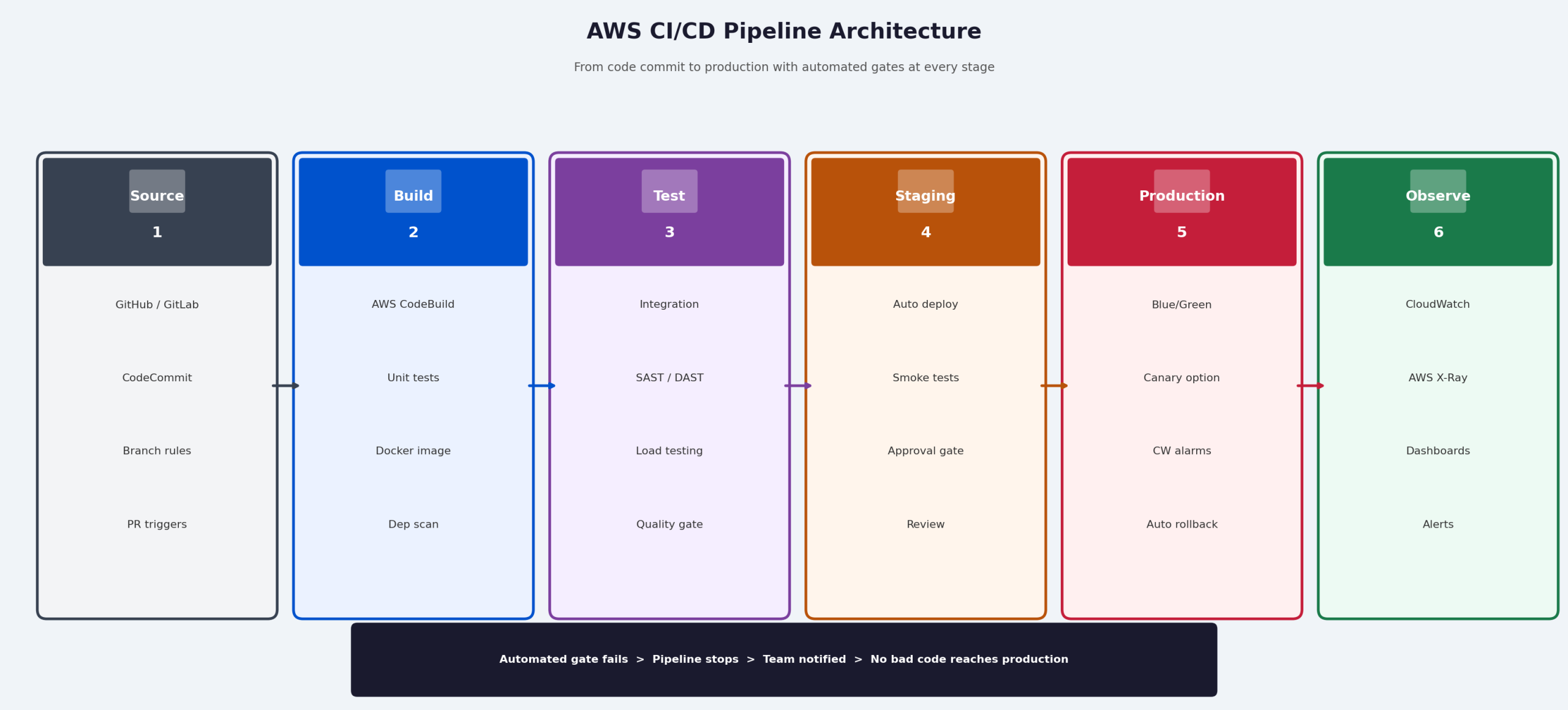
Figure 3: Six-stage AWS CI/CD pipeline from source commit to production. Every stage includes automated gates. No code reaches production without passing all of them.
- Source: AWS CodePipeline connects to GitHub, GitLab, Bitbucket, and CodeCommit. Branch protection rules ensure no code proceeds without a peer review and passing status check.
- Build with CodeBuild: Fully managed build environment. Compiles code, runs unit tests, packages the artefact. Integrates with AWS Secrets Manager so credentials never appear in build logs.
- Test: Integration tests, SAST security scanning, dependency vulnerability checks, and load testing run automatically. Code that fails any gate is stopped and the developer is notified immediately.
- Staging with Approval Gate: Auto-deploys to staging, runs smoke tests, and presents a manual approval step before production. Approval is logged and timestamped as part of the audit trail.
- Production with CodeDeploy: Deploys using the strategy appropriate for the workload. CloudWatch monitors key metrics and triggers automatic rollback if error rates or latency degrade beyond the defined threshold.
- Observe with CloudWatch and X-Ray: Continuous metric tracking, distributed tracing, and deployment markers so your team sees exactly what changed when, and where any issue originates.
5. Choosing the Right Deployment Strategy
The pipeline delivers code to production. The deployment strategy determines how safely it arrives.
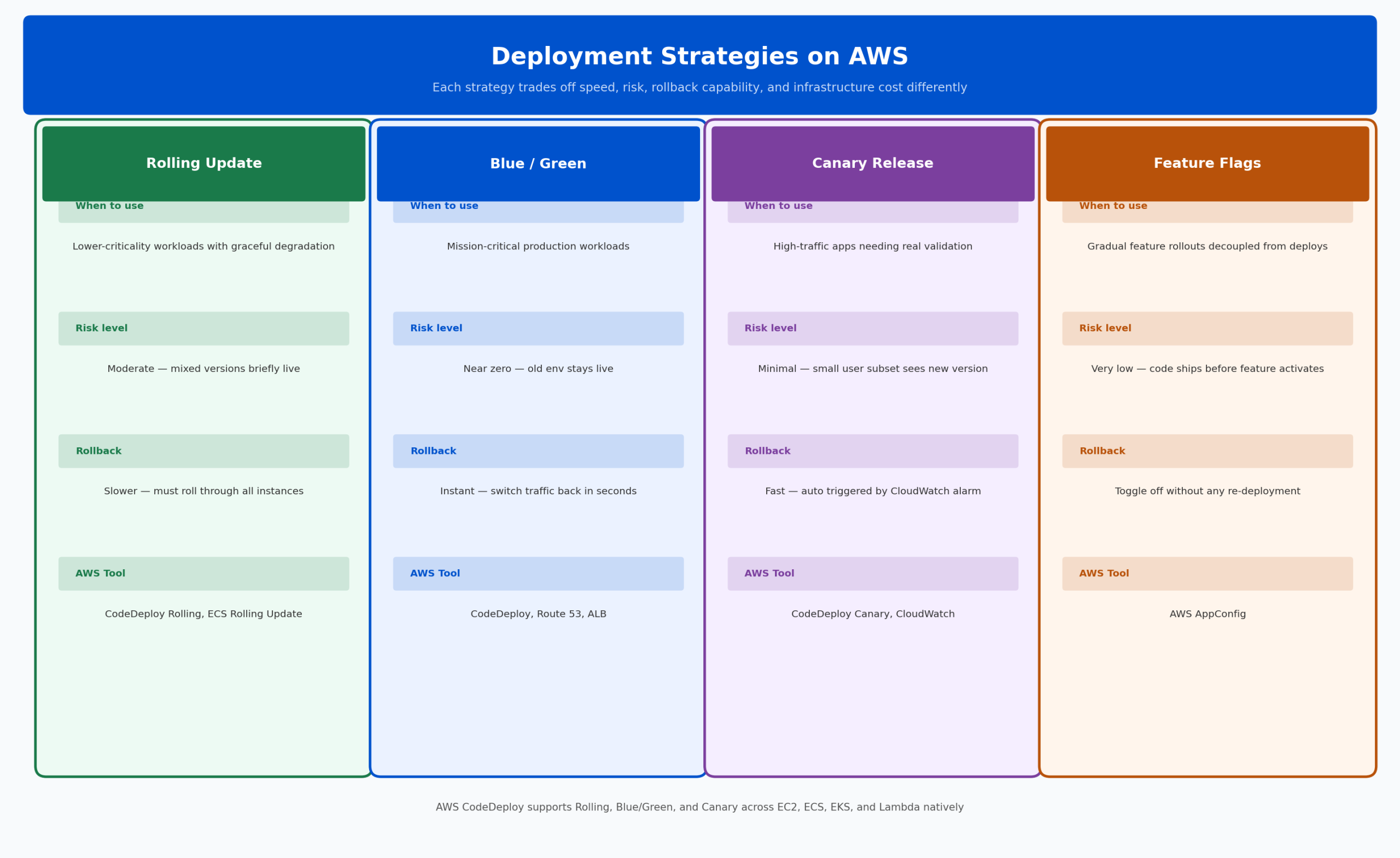
Figure 4: Four deployment strategies on AWS compared by risk, rollback speed, and infrastructure cost. AWS CodeDeploy supports all four natively.
- Blue/Green: Full parallel environment. Switch traffic from current to new in one action. Instant rollback if anything degrades. The right default for mission-critical production workloads.
- Canary: Route a small percentage of traffic to the new version first. CloudWatch monitors error rate and latency. Expand progressively on success, roll back automatically on failure. Right for high-traffic applications needing real-world validation.
- Rolling: Replace instances gradually. Lower cost than Blue/Green. Right for lower-criticality workloads with graceful degradation.
- Feature Flags with AWS AppConfig: Deploy code without activating features. Enable for specific users or traffic percentages independently of the deployment. Separates deployment from release entirely.
6. Infrastructure as Code and Secrets Management
Your pipeline is infrastructure. It should be version-controlled, peer-reviewed, and deployed the same way your application code is. If it exists only as manual console configurations, it is not reproducible, not auditable, and one misclick away from breaking your entire delivery capability.
- AWS CDK: Define your pipeline in TypeScript, Python, or Go. CDK Pipelines creates self-mutating pipelines that update themselves as part of a deployment. Your pipeline becomes a code artefact reviewed in pull requests.
- GitHub Actions with OIDC Federation: Eliminates long-lived AWS credentials stored as GitHub secrets. Your build environment authenticates with AWS using temporary credentials scoped to exactly the permissions needed.
- AWS Secrets Manager: No credential, API key, or certificate should appear in pipeline configuration as plaintext. Secrets Manager provides centralized storage with automatic rotation and native integration with CodeBuild, ECS, EKS, and Lambda.
7. AWS DevOps Agent and Kiro: The Agentic Layer
Two AWS services released in late 2025 and 2026 are beginning to change the DevOps operating model in a meaningful way. Both are production-ready and available today.
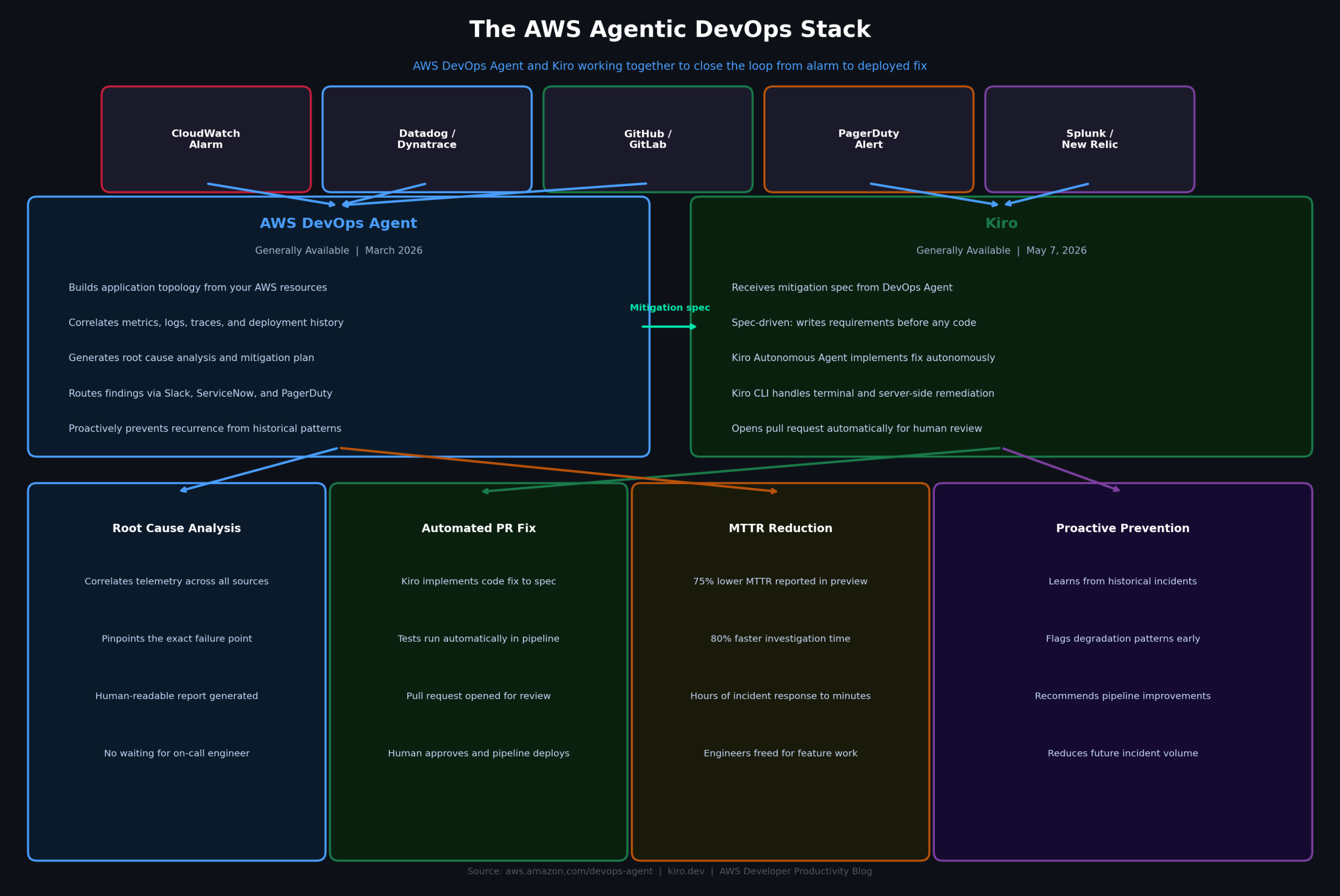
Figure 5: AWS DevOps Agent investigates incidents autonomously and generates mitigation specs. Kiro implements the fix and opens the pull request. The only manual step is the review before deployment.
AWS DevOps Agent
Launched in preview in December 2025, generally available from March 2026. When a CloudWatch alarm fires, or Datadog, Dynatrace, New Relic, or Splunk detect an anomaly, AWS DevOps Agent begins investigating immediately. It builds an application topology from your resources, correlates metrics, logs, traces, and deployment history autonomously, and generates a root cause analysis and mitigation plan in minutes. During the preview period, customers reported a 75 percent reduction in mean time to resolution and 80 percent faster investigations. The agent routes findings through Slack, ServiceNow, and PagerDuty automatically. Beyond incident response, it analyses patterns across historical incidents to proactively recommend improvements to your pipeline, observability, and infrastructure.
Kiro
Announced in July 2025, generally available from May 7, 2026. Kiro is AWS’s spec-driven agentic IDE and the successor to Amazon Q Developer for IDE-based AI assistance. New Amazon Q Developer signups were closed from May 15, 2026. Kiro’s design principle is that it generates a structured specification, including requirements, design, and a task list, before writing any code. Those files stay in your repository as living documentation. For DevOps workflows, the Kiro CLI receives mitigation specifications from AWS DevOps Agent, implements the fix across the relevant files, and opens a pull request automatically. The Kiro Autonomous Agent operates in the background picking up tasks and opening PRs without a human in the loop.
The combined workflow: CloudWatch alarm fires. DevOps Agent investigates and generates a mitigation spec. Kiro CLI implements the fix and opens a pull request. Engineer reviews and approves. Pipeline deploys. The entire cycle completes in minutes, not hours. The only human step is the pull request review.
8. Where Your Team Sits Today
Most MENA enterprise teams operate between Level 2 and Level 3 on the DevOps maturity model. Some automation exists but deployment is still stressful, metrics are not consistently tracked, and the pipeline is not yet fully trusted. The move from Level 2 to Level 3 is achievable in a focused 90-day program.
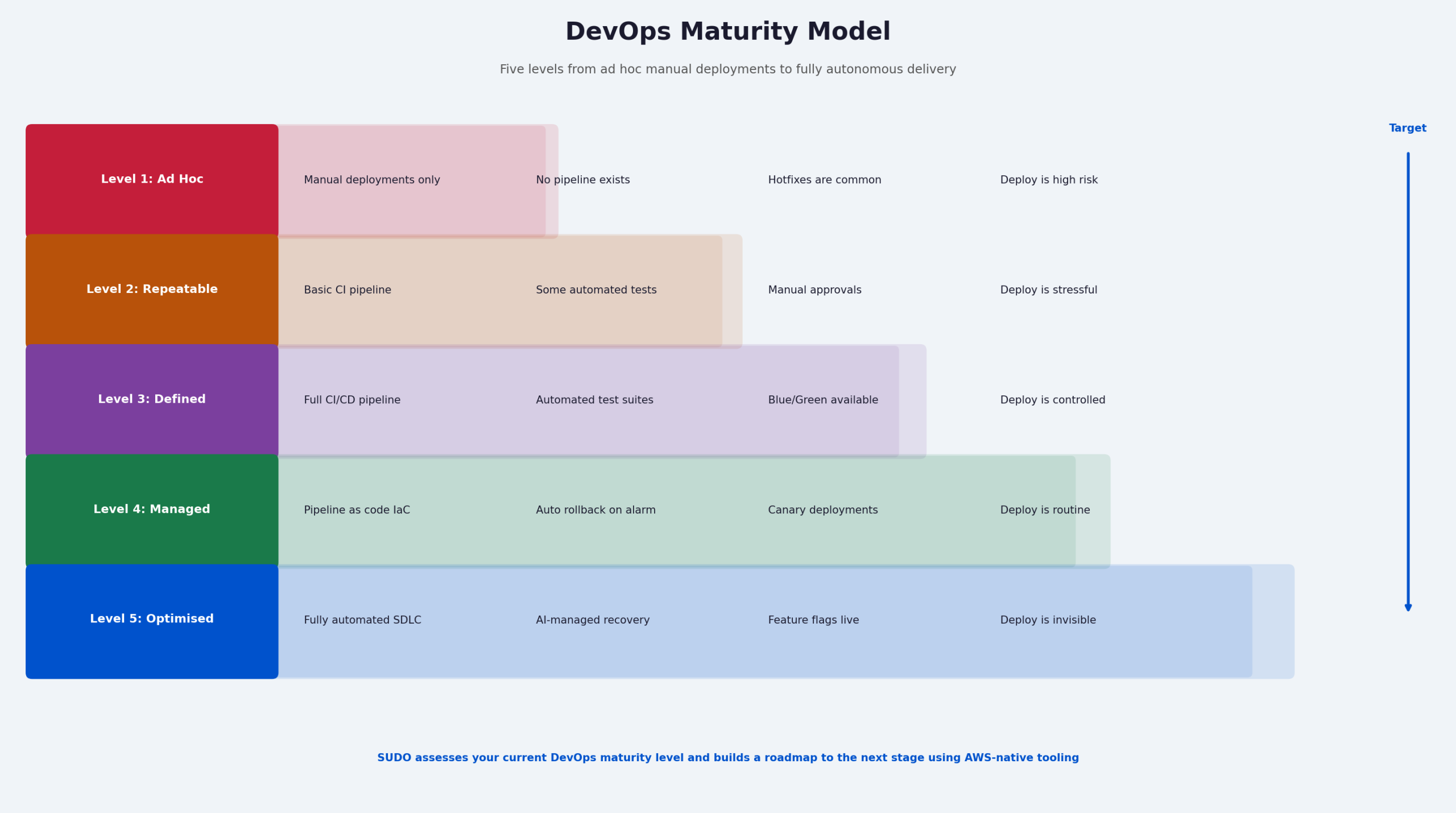
Figure 6: DevOps Maturity Model from ad hoc manual deployments to fully autonomous delivery. The gap between most MENA enterprise teams and Elite is investment, not capability.
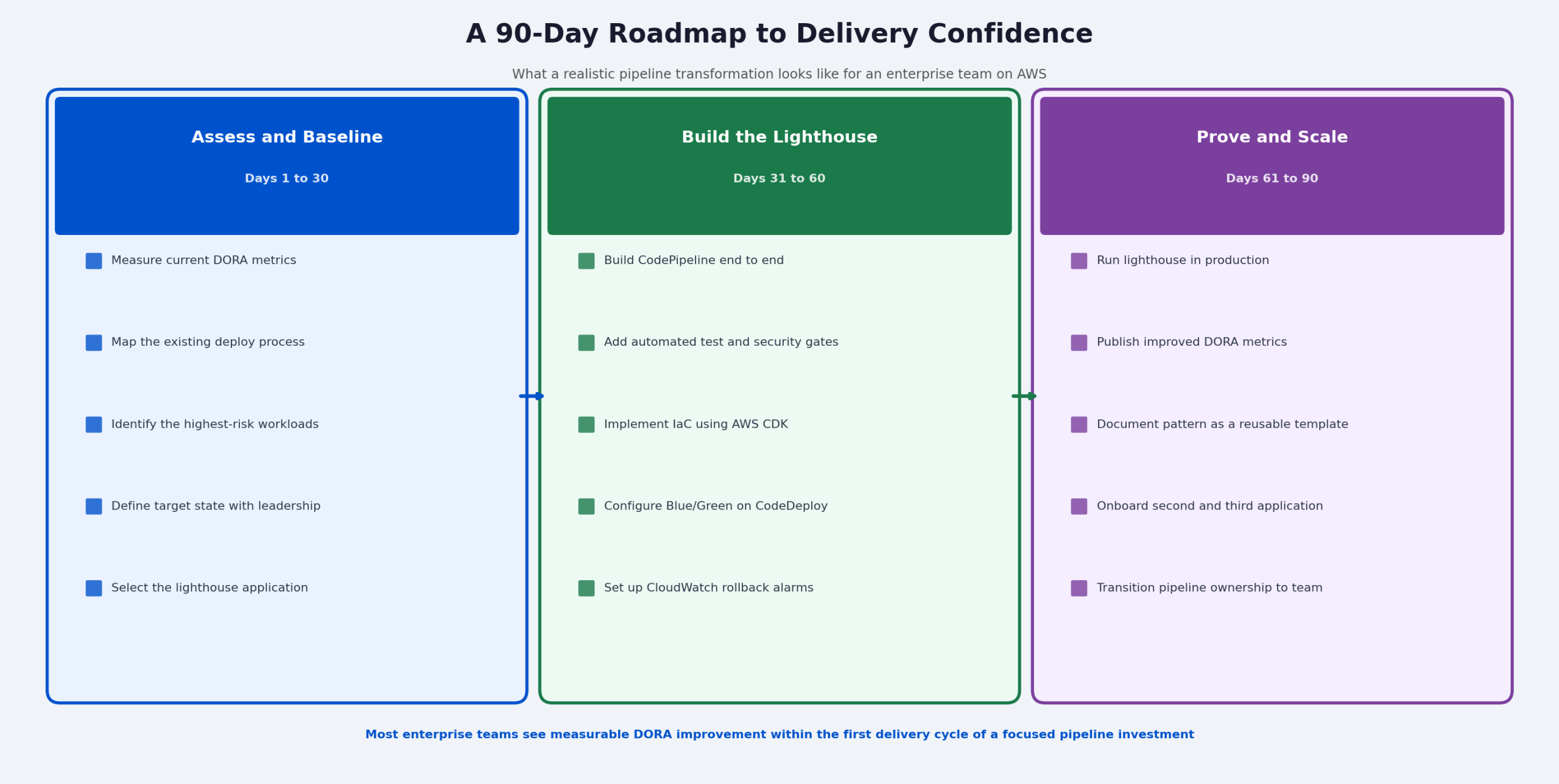
Figure 7: A 90-day roadmap from manual deployments to production-grade CI/CD on AWS. Most teams see measurable DORA improvement within the first delivery cycle.
9. The Cultural Shift and How SUDO Helps
Pipeline architecture solves the technical problem. Culture determines whether the investment sticks. Automation changes who owns what, from a small group of people with deployment access to a pipeline the whole team trust. Teams that make this transition successfully do three things: they start with one application fully automated and demonstrate it working before asking the organisation to follow; they publish DORA metrics so the improvement is visible; and they treat pipeline failures in lower environments as learning opportunities rather than incidents.
We have designed and built delivery pipelines for enterprise teams in banking, retail, logistics, and government across the UAE and KSA. Every engagement starts with a DevOps maturity assessment and DORA baseline, and builds a programme around your specific workloads, team, and compliance requirements.
- DevOps maturity assessment and DORA baseline measurement
- CI/CD pipeline build using CodePipeline, CodeBuild, and CodeDeploy
- Blue/Green and canary deployment configuration across EKS, ECS, EC2, and Lambda
- Infrastructure as Code using AWS CDK or Terraform with self-mutating pipelines
- GitHub Actions integration using OIDC federation
- AWS DevOps Agent integration for autonomous incident investigation
- Kiro implementation for spec-driven development and agentic code remediation
- Team enablement, ownership transition, and DORA tracking dashboards
Stop Fearing Deployments. Start Owning Them.
Book a free DevOps maturity review with SUDO. We will show you exactly where your team sits and what it takes to build delivery confidence on AWS.
Get in touch at sudoconsultants.com or [email protected]
► Review Your DevOps Maturity and Pipeline Architecture with SUDO →
Explore SUDO’s DevOps and Automation services built on AWS.
► View Our DevOps and Automation Services →
Frequently asked questions
- What does a failed deployment actually cost? – Beyond time to recovery, a failed deployment hits four business dimensions: wasted senior-engineer time, lost customer trust and revenue during outages, missed launch windows, and eroded leadership confidence in the delivery team.
- What are the DORA metrics? – The four DevOps Research and Assessment metrics: deployment frequency, lead time for changes, change failure rate, and mean time to recovery. Together they measure the health of a delivery process better than any internal dashboard.
- What does a production-grade AWS CI/CD pipeline look like? – Six stages, each with an automated gate: source (CodePipeline), build and unit tests (CodeBuild), automated testing and security scans, staging with an approval gate, production with CodeDeploy and automatic rollback, and observability with CloudWatch and X-Ray.
- Which AWS deployment strategy should I use? – Blue/Green for mission-critical workloads, Canary for high-traffic apps needing real-world validation, Rolling for lower-criticality workloads, and Feature Flags with AWS AppConfig to separate deployment from release. AWS CodeDeploy supports all four natively.
- What are AWS DevOps Agent and Kiro? – AWS DevOps Agent (generally available from March 2026) autonomously investigates incidents and generates a root-cause analysis and mitigation plan in minutes. Kiro (generally available from May 2026), AWS’s spec-driven agentic IDE and successor to Amazon Q Developer, implements the fix and opens the pull request.
Keywords: AWS CI/CD pipeline, DevOps on AWS, DORA metrics, blue/green deployment AWS, AWS CodePipeline, AWS DevOps Agent, Kiro, delivery confidence MENA