

As enterprises accelerate the adoption of AI agents for infrastructure automation, the AWS Model Context Protocol (MCP) Server is emerging as a powerful enabler, allowing AI assistants to manage AWS environments using natural language. But with this new capability comes an expanded security surface that must be intentionally designed and governed.
At SUDO, we help organizations adopt MCP Server securely, responsibly, and at scale. This blueprint outlines how AWS secures MCP, where customer responsibility begins, and how SUDO partners with AWS to operationalize best-in-class cloud security for AI-driven operations.
Understanding the AWS Security Foundation (and Where SUDO Steps In)
AWS operates under a Shared Responsibility Model:
- Security of the cloud – AWS protects physical data centers, the underlying infrastructure, networking, and managed services.
- Security in the cloud – Customers define access controls, data protection, compliance policies, and operational guardrails.
SUDO bridges this divide by translating AWS security primitives into practical, enforceable operating models for AI agents powered by MCP Server. We align AWS-native controls with enterprise risk, compliance, and governance requirements, so MCP adoption doesn’t outpace security maturity.
1. Data Protection: Encryption, Visibility, and Control
Data protection is more than encryption; it’s about knowing exactly what your AI agents are doing.
AWS Capabilities
- TLS 1.2+ for secure communications
- Encryption at rest and in transit
- AWS CloudTrail for API-level auditability
How SUDO Supports Clients
- Design end-to-end logging architectures that capture MCP agent actions across accounts and regions
- Centralize CloudTrail logs into CloudWatch, OpenSearch, or SIEM platforms for advanced threat detection
- Define retention and immutability strategies aligned to regulatory requirements
- Implement tagging and metadata strategies to trace AI-initiated actions back to business context
This ensures MCP-driven automation remains auditable, compliant, and forensically sound.
2. Identity and Access Management: Least Privilege for AI Agents
IAM is the most critical control plane for MCP Server deployments.
AWS Best Practices
- Start with AWS managed policies
- Apply least-privilege access
- Enforce MFA for sensitive operations
- Use IAM Access Analyzer to detect overly permissive policies
How SUDO Supports Clients
- Design agent-specific IAM roles with narrowly scoped permissions
- Separate read, plan, and apply capabilities for AI agents
- Implement permission boundaries and Service Control Policies (SCPs) to prevent privilege escalation
- Continuously validate policies using automated IAM analysis and security reviews
SUDO ensures AI agents can act confidently, but never recklessly.
3. Secure Workflows with MCP Agent SOPs
AWS MCP Server introduces Agent Standard Operating Practices (SOPs), codified workflows that enforce security defaults.
AWS SOP Capabilities
- Secure-by-default resource creation
- Enforced HTTPS, secure S3 policies, and proper network isolation
- Consistent tagging and configuration standards
How SUDO Supports Clients
- Customize SOPs to match enterprise security baselines
- Embed compliance controls (HIPAA, SOC 2, ISO, PCI) directly into agent workflows
- Standardize secure patterns for VPCs, IAM roles, storage, and compute
- Prevent misconfigurations like public buckets or open security groups, before they ever reach production
This allows organizations to scale AI automation without scaling risk.
4. Defense-in-Depth for AI-Driven Cloud Operations
MCP Server is powerful, but no single control is enough.
Monitoring & Alerting
SUDO implements
- Real-time monitoring of MCP agent activity
- Behavioral alerts for anomalous API usage
- Integration with SOC workflows and incident response playbooks
Human-in-the-Loop Controls
SUDO designs
- Approval gates for high-risk actions (IAM changes, production deletes)
- Tiered trust models where agents earn autonomy over time
- Audit-friendly approval workflows
Testing & Scanning
SUDO integrates
- IaC scanning tools like Checkov and Semgrep
- Policy-as-code validation before MCP execution
- Continuous security testing pipelines for AI-initiated infrastructure changes
Emerging Security Challenges in MCP Implementations
AI-driven automation introduces new threat vectors beyond traditional DevOps:
- Prompt injection attacks
- Tool poisoning and the MCP supply-chain risks
- Reduced observability if logging is incomplete
How SUDO Mitigates These Risks
- Provenance tracking for agent inputs and tool execution
- Inline policy enforcement to constrain agent behavior
- Sandboxing and isolation of untrusted MCP components
- Secure prompt design and validation frameworks
Our approach treats AI agents as high-privilege actors that require stronger guardrails, not fewer.
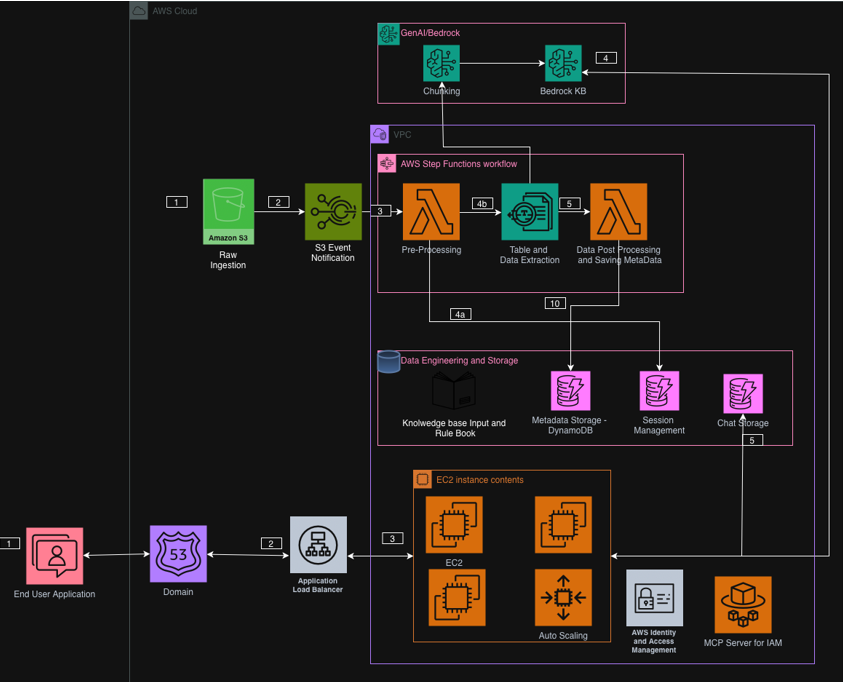
Conclusion: Secure by Default, Secure by Design, with SUDO
The AWS MCP Server unlocks a new era of AI-assisted cloud operations. But success depends on how securely it’s implemented.
SUDO helps organizations:
· Align MCP adoption with AWS’s shared responsibility model
· Design least-privilege IAM for AI agents
· Embed security into MCP SOPs and workflows
· Build defense-in-depth controls that scale with automation
The result? Faster innovation, stronger governance, and confidence in every AI-driven action.
Start secure. Stay secure. Scale intelligently, with SUDO.
